A terminal operator at a container port in Antofagasta finishes a shift and submits his maintenance log on paper. Three open equipment findings, one PPE compliance gap, two container handling notes. The paper goes to the operations office. An analyst enters it into the system the next morning. By the time the port operations manager sees it, the terminal has processed 14 more shifts and the findings are 26 hours old.
This is what port operations data looks like when it runs on paper — and it's what a 24–72 hour data lag means in a high-throughput environment where decisions about equipment deployment, crew safety, and compliance reporting need to happen in real time.
Ultraport, one of the largest port operators in northern Chile, reduced shift paperwork from 80 minutes to 40 minutes and reclaimed 60 hours per month across their operations after eliminating paper-based workflows. That's the scale of the problem — and the scale of what closing the First Mile gap delivers.
Why Port Operations Have a Field Data Problem
Ports and terminals operate at the intersection of high throughput, strict compliance, and continuous shift operations — conditions that expose every weakness in paper-based data collection:
- Continuous 24/7 operations across shifts. Port operations don't stop. Shift handoffs happen every 8–12 hours, and the quality of each handoff depends on the accuracy and completeness of the outgoing shift's field records. When those records are on paper — submitted, collected, and transcribed hours later — the incoming shift starts on incomplete information.
- High-stakes safety and compliance environment. Port operations are subject to safety authority oversight, insurance requirements, and regulatory compliance that demand accurate, timestamped records of equipment inspections, incident reports, and PPE compliance audits. Paper forms that get transcribed after the fact — with gaps, errors, and missing signatures — create compliance liability at every audit.
- Distributed operations across large physical areas. Container terminals, bulk cargo facilities, and port maintenance yards span large areas where field workers are rarely near a desk or stable Wi-Fi. Equipment inspections happen at the crane, not the office. Incident reports get written on clipboards in the yard. The data starts as paper because the tools available to field workers are paper.
- Equipment-intensive operations with maintenance criticality. Port cranes, spreaders, reach stackers, and terminal tractors require regular inspection and maintenance. When equipment fault reports sit on clipboards until end of shift and reach the maintenance team the next morning, the window to address a developing fault before it becomes a breakdown has already closed.
What the Data Gap Costs Port Operations
The Shadow Tax in port operations accumulates across three categories:
Shift report time — the visible cost. Ultraport documented 80 minutes of paperwork per terminal operator per shift before deploying eSkuad. Across multiple operators and multiple shifts per day, this represents thousands of minutes of manual documentation time that generates no operational value — only records that arrive too late to act on. The 40-minute reduction eSkuad delivered represents 60 hours per month reclaimed for productive operations work.
Compliance gaps — the liability cost. Port operations are inspected by safety authorities, port state control, and insurance auditors. Inspections require complete, accurate records of equipment maintenance, safety audits, and incident reports. When those records are assembled from handwritten forms and partial transcription, gaps are inevitable. Each gap is a compliance finding. Each compliance finding has a cost — in fines, in remediation time, in audit resources.
Equipment availability — the operational cost. A crane that goes down mid-shift because a maintenance finding went unaddressed for 26 hours doesn't just cost a repair — it costs the throughput of every container that crane would have moved. In high-throughput terminal operations, equipment availability is directly tied to revenue. The data lag between a field finding and a maintenance response is the gap where equipment downtime is born.
What Offline-First Field Operations Software Delivers in Ports
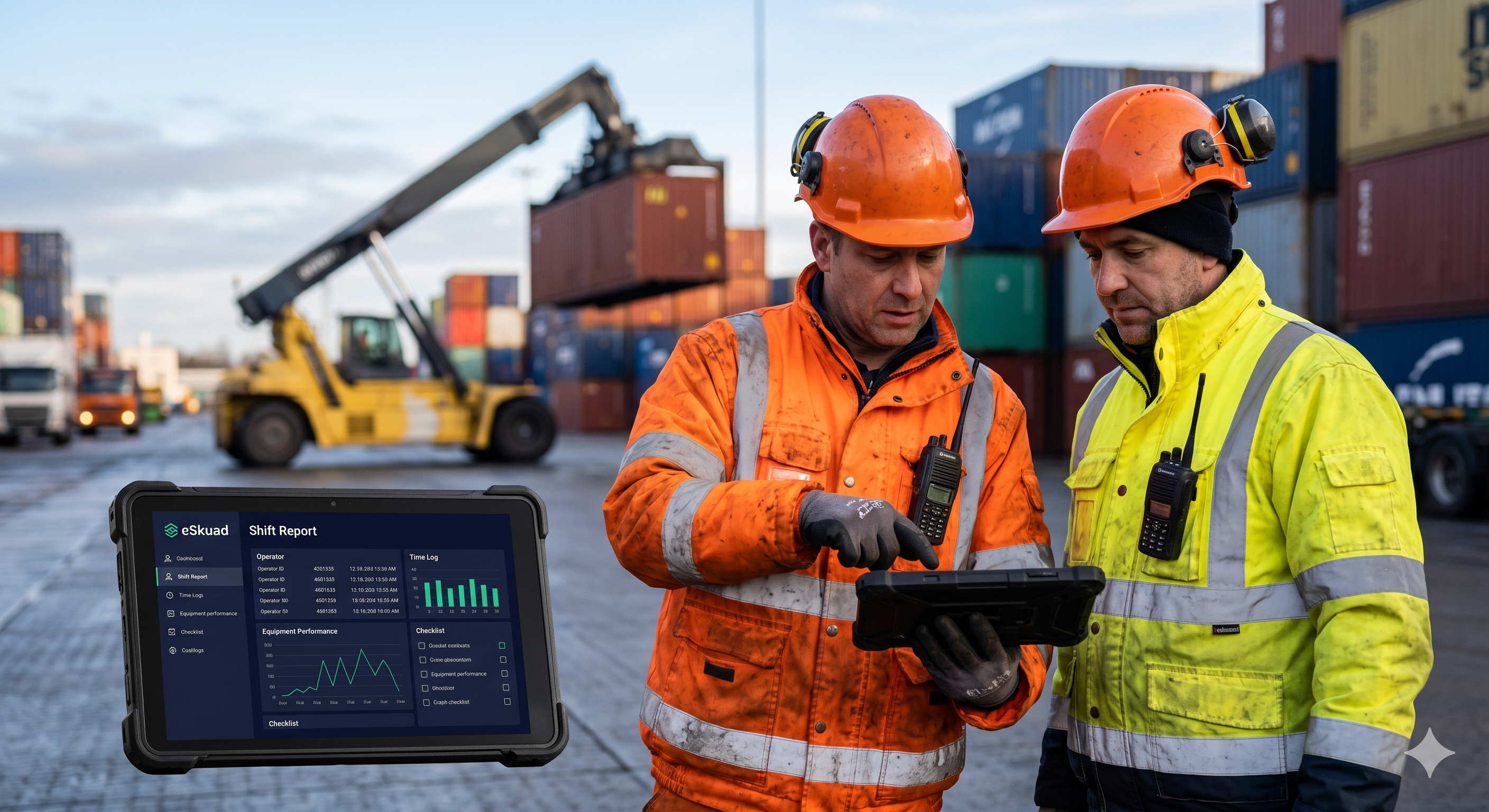
Shift reports in half the time. eSkuad's field app replaces paper forms with digital workflows optimized for field conditions — large tap targets, photo capture, GPS auto-population, and digital signature. Terminal operators submit shift reports in the field, not at a desk. Paperwork that took 80 minutes takes 40. The data is in the system the moment it's submitted, not 26 hours later.
Equipment inspection records with photo evidence. Crane operators, maintenance crews, and equipment inspectors capture findings with photo documentation directly attached to the inspection record. GPS coordinates stamp the location. Digital signatures confirm the inspector. The record is immutable, timestamped, and audit-ready — without a single step of transcription.
Automatic maintenance triggers. When a field inspection finds an equipment fault, eSkuad's workflow engine can automatically route the finding to the maintenance team, create a work order, and notify the supervisor — without manual intervention. The 26-hour gap between finding and response becomes a minutes-gap.
Real-time shift visibility for operations managers. When field data syncs from multiple terminal areas simultaneously, the port operations manager sees the current state of the terminal — what's been inspected, what findings are open, where the shift is running behind — without waiting for the analyst to compile the morning report. Dashboard Delusion is replaced by operational truth.
Compliance documentation that holds up at audit. Every eSkuad record is timestamped, GPS-stamped, signed, and tamper-evident. The full inspection history for any piece of equipment — or any terminal area — is searchable and exportable in minutes. Safety authority requests for 90 days of records get answered in 90 seconds, not 90 hours of manual document assembly.
How Port Operations Teams Use eSkuad
Shift reporting and handoffs. Terminal operators submit end-of-shift reports digitally from the field. Incoming shift supervisors see full handoff context before they take over. Operations managers have the terminal's status picture before the daily review meeting.
Equipment inspections. Pre-shift and post-shift equipment checks generate digital records with photo evidence and automatic maintenance routing. Equipment history is complete, searchable, and audit-ready.
Safety and incident reporting. Near-miss events, PPE compliance checks, and safety observations are captured at the moment they occur — with GPS location, photo evidence, and supervisor notification. Safety data doesn't wait for end of shift or next-morning transcription.
Maintenance work orders. Field findings automatically generate maintenance work orders routed to the appropriate team. Maintenance managers see open findings in real time and can prioritize responses before equipment failure.
Getting Started
eSkuad's free tier supports up to 5 users with no credit card required. The standard validation approach for port operations: deploy shift reporting or equipment inspection for one terminal crew for two weeks. Measure the reduction in paperwork time, the improvement in data completeness, and the time between field findings and maintenance response. Ultraport's 60 hours per month is a benchmark — the specific number for your terminal depends on your current paperwork volume.
Frequently Asked Questions
What field operations software do port and terminal operations use?
Port operations teams typically manage field data through a combination of paper forms, Excel-based shift reports, and manual transcription into ERP or maintenance systems. eSkuad replaces this workflow with an offline-first mobile platform that captures shift reports, equipment inspections, safety audits, and maintenance records digitally — with automatic sync, GPS stamping, and compliance-ready record formats. Ultraport, one of the largest port operators in northern Chile, uses eSkuad across their terminal operations.
How does eSkuad reduce shift paperwork time in port operations?
eSkuad reduces shift paperwork time by replacing paper form completion and manual transcription with digital capture at the point of activity. Terminal operators submit shift reports, equipment findings, and safety observations through a mobile app optimized for field conditions — large tap targets, photo capture, works without Wi-Fi. Ultraport documented a reduction from 80 minutes to 40 minutes of shift paperwork per operator after deploying eSkuad, saving 60 hours per month across their operations.
How does field data software help with port compliance documentation?
Port operations compliance — safety authority inspections, insurance audits, regulatory submissions — requires complete, accurate, timestamped records. eSkuad generates tamper-evident records with GPS coordinates, digital signatures, and photo evidence at the point of field capture. Records are immediately available for audit requests without manual assembly from paper files. eSkuad's Enterprise tier is SOC 2 Type 2 certified, meeting enterprise procurement security requirements.
Can port operations software integrate with existing maintenance management systems?
eSkuad's Enterprise tier provides unlimited API access for integration with maintenance management systems, ERP platforms, and BI tools. Field findings captured by terminal operators can automatically trigger work orders in downstream systems, eliminating the manual step of converting a field report into a maintenance request. This is the integration layer that closes the gap between field capture and operational response.
What is the Shadow Tax in port operations?
The Shadow Tax in port operations is the hidden monthly cost of paper-based field workflows: analyst hours spent transcribing shift reports, equipment downtime from maintenance findings that arrived too late, compliance penalties from incomplete documentation, and operations decisions made on data that's 24–72 hours old. The Shadow Tax doesn't appear on any invoice — it shows up as overtime, equipment repair costs, and compliance findings that could have been prevented with real-time field data.