
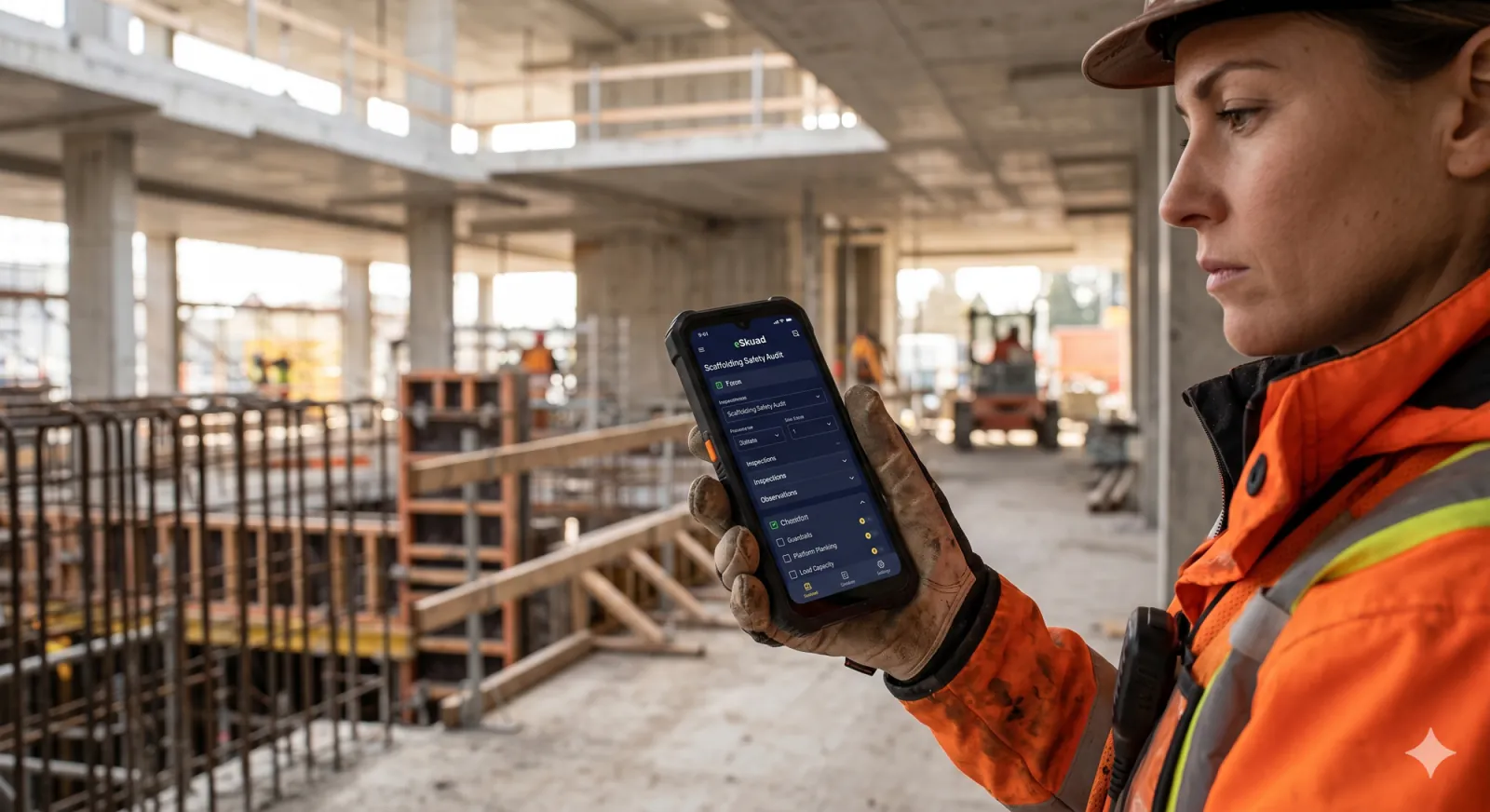
A field workaround is the informal path crews use to move information when the official software does not fit the job: text messages, photos, paper notes, and someone re-entering it all at the computer later. The work gets done. But every record is captured twice, arrives late, and is hard to trust.
Here is what surprised us most in recent evaluation meetings. The teams we meet are rarely starting from zero. They already have software. The field just works around it.
What it looks like in a US operation
The pattern repeats across maintenance shops, job sites, and yards.
- Collected by text. A technician finishes an inspection and texts a few photos and a quick note to the supervisor. Or writes it on a paper checklist to hand in at the end of the shift.
- Re-entered at the computer. Someone in the office, usually the person who knows the forms app best, pieces the texts and paper together and types it all in again.
- Late and hard to trust. By the time management sees it, the shift is over. Nobody is sure what was missed, misread, or never sent.
Nobody designed it this way. It grew because every step made sense on its own. Texting is fast. The office is comfortable at the computer. The old forms app works well enough for the person who uses it every day.
Why crews work around the software
When we ask why, the answers are rarely about resistance to change. They are practical.
- The app expects signal. In a yard, a basement, or a remote site, it hangs or loses the entry. A text message waits patiently until it can send.
- It was built for the desk. Long forms, small buttons, and required fields that make sense at a computer are painful with gloves on and a machine running.
- The reports do not match what people need. So the data ends up exported and rebuilt somewhere else anyway.
- Nobody measures the re-entry. It does not appear on any report, so it never looks like a problem worth fixing.
That last point is the important one. The double entry is real work, done every shift, by people who could be doing something else.
What the workaround costs
The cost rarely shows up as a line item. It shows up as time, delay, and doubt.
Time. Every record handled twice costs minutes, every shift, for every crew. When one port operation moved shift reports to a single capture on the phone, paperwork dropped from 80 to 40 minutes per shift.
Delay. Maintenance decisions, safety follow-ups, and invoices all wait for the office to catch up.
Trust. When an auditor, a customer, or a manager asks what happened, the honest answer is often: “Let me check the texts.”
Five questions to find your workaround
Ask these of your own operation this week:
- Who re-enters field data today, and how many hours a week does it take?
- Which checklists or forms still arrive as photos, texts, or paper?
- How long between when work happens in the field and when management sees it?
- Which reports are rebuilt by hand outside your system?
- If an auditor asked for last month’s inspections, how long would it take to answer?
If any answer makes you wince, you have found your starting point. You have also found the baseline for a business case your committee can defend.
Fix it without ripping anything out
The answer is not another app the office has to learn from scratch. It is to capture the record once, at the source, and send it where it needs to go.
- Let the crew finish the record on their phone, even without signal. The data is saved on the device first and syncs when it can.
- Keep the office at the computer. Review, approve, and report from the desktop, without retyping anything.
- Connect to what you already have. Field data can flow into your existing system through an API instead of competing with it.
- Start with the process you run today. Digitize the checklist crews already know, then improve it.
Where eSkuad fits
eSkuad is field operations software built for exactly this gap. Crews complete forms on any phone, with GPS, time, photos, and signatures, even without signal. MagikSync™ saves each record on the device first and syncs by priority, without draining the battery. Reports in PDF and spreadsheet are generated automatically, and integrations connect through APIs in days or, at most, weeks.
If your team needs a formal decision point, our optional 90-day Value Confirmation Program starts by measuring the current process, so the result is compared with your own numbers.
The goal is simple: the shift ends, and the report is already done.
Related reading: Pillo Hacks: the hidden system running your field operations and the field software decision you can defend.
Frequently Asked Questions
What is a field workaround?
A field workaround is the informal path crews use to move information when the official software does not fit the job: text messages, photos, paper notes, and someone re-entering it all at the computer later. The work gets done, but every record is captured twice and arrives late.
Why do field crews avoid the forms app their company already has?
Usually because the app was designed for the office, not the field. It needs signal, takes too many taps with gloves on, or produces reports nobody uses. Texting the office is simply faster, so crews do that.
How do you measure the cost of double entry?
Count who re-enters field data, how many records they handle per shift, and how long each one takes. Add the delay between when work happens and when management sees it. Those numbers become the baseline for any business case.
Do you have to replace your current system to fix it?
No. The fix is to capture the record once, at the source, and send it where it needs to go. The office can keep working at the computer, and field data can flow into existing systems through an API.