Last updated: June 4, 2026
An operations director at a large forestry company once described her technology stack to us this way: "We have the best field data collection tool we've ever used. And we have the best reporting platform we've ever used. And they hate each other."
Her field supervisors used a mobile app to log productivity, safety observations, and equipment status across remote forest tracts in southern Chile. Her operations team used a sophisticated BI platform to analyze performance and generate client reports. Between the two: a daily ritual of CSV exports, copy-paste reconciliation, and manual data cleaning that consumed two full analyst days per week.
This is the Two-Product Problem — and it is the structural cause of some of the most expensive inefficiencies in industrial field operations.
What Is the Two-Product Problem?
The Two-Product Problem occurs when an organization buys separate tools for field data capture and management visibility — and those tools were never designed to work together.
The pattern is predictable:
- The field team needs something that works offline, is easy to use under pressure, and doesn't drain battery. They evaluate and buy Tool A.
- The operations team needs dashboards, automated reports, and integrations with the ERP. They evaluate and buy Tool B.
- Procurement is satisfied. Both tools received excellent reviews from their respective users. The project is marked complete.
- Six months later, the company has two excellent tools that have never spoken to each other — and a team of analysts spending their days building the bridge between them manually.
The tools are not failures. The architecture is.
Why the Two-Product Architecture Persists
The Two-Product Problem survives procurement cycles because it is invisible at purchase time. When you evaluate a field data capture tool, you test it in the field — and it performs beautifully. When you evaluate a BI reporting platform, you test it in the boardroom — and it performs beautifully. The failure mode only appears in production, when data captured in the field needs to appear in the dashboard and there is no automatic path for it to get there.
Several organizational patterns accelerate the problem:
- Separate buyers. The field operations manager and the IT director rarely evaluate tools together. They optimize for their own users and their own criteria.
- Sequential purchasing. Tool A was bought in 2019 for field capture. Tool B was bought in 2022 for reporting. Neither was selected with the other in mind.
- Integration optimism. Both vendors claimed their tool integrates with everything. The API documentation looked solid. In practice, the integration requires custom development that was never scoped or budgeted.
- Workaround normalization. The CSV export + manual cleanup routine runs for 6 months before anyone calculates what it costs. By then, it has become "just how we do it."
The Translation Layer: Where the Shadow Tax Lives
Between Tool A and Tool B sits what we call the translation layer — the manual process of moving data from field capture to management visibility. It is the most expensive part of the entire stack, and it appears on no vendor invoice.
The translation layer costs:
- Time: 128+ analyst hours per month in transcription, cleaning, and reconciliation — across industries and company sizes, this is the consistent finding from First Mile operations using two-product architectures.
- Latency: A 24 to 72 hour lag between when field data is captured and when it appears in the management dashboard. In fast-moving industrial operations, this is the difference between catching a problem and discovering it after the damage is done.
- Accuracy: Every manual handoff introduces error. Data copied from one system to another — even by careful analysts — accumulates mistakes that compound in ways that are difficult to detect and expensive to correct.
- Compliance exposure: When the field record and the management record diverge — as they inevitably do in manual translation — the compliance audit trail breaks. Regulators expect a continuous chain of custody from capture to report. Two-product architectures create gaps.
Dashboard Delusion: The Leadership View
The most damaging consequence of the Two-Product Problem is not the analyst overtime. It is the false confidence it creates in leadership.
When operations directors look at their BI dashboards and see green metrics, they believe they are seeing the current state of the operation. They are not. They are seeing the state of the operation as it was captured in the field, exported to CSV, cleaned by an analyst, and imported into the BI tool — a process that completed sometime in the last 24 to 72 hours.
We call this Dashboard Delusion: the false sense of operational control that executives experience when their management tools show green metrics while field-level data is still in transit through the translation layer.
Decisions made under Dashboard Delusion are made with outdated information. Equipment failures incubate in the gap. Compliance violations occur in the gap. Operational improvements remain invisible in the gap.
The Alternative: One Platform, Two Surfaces
The solution to the Two-Product Problem is not to find two products that integrate better. Integration is a workaround for an architectural failure — it reduces the translation layer but does not eliminate it.
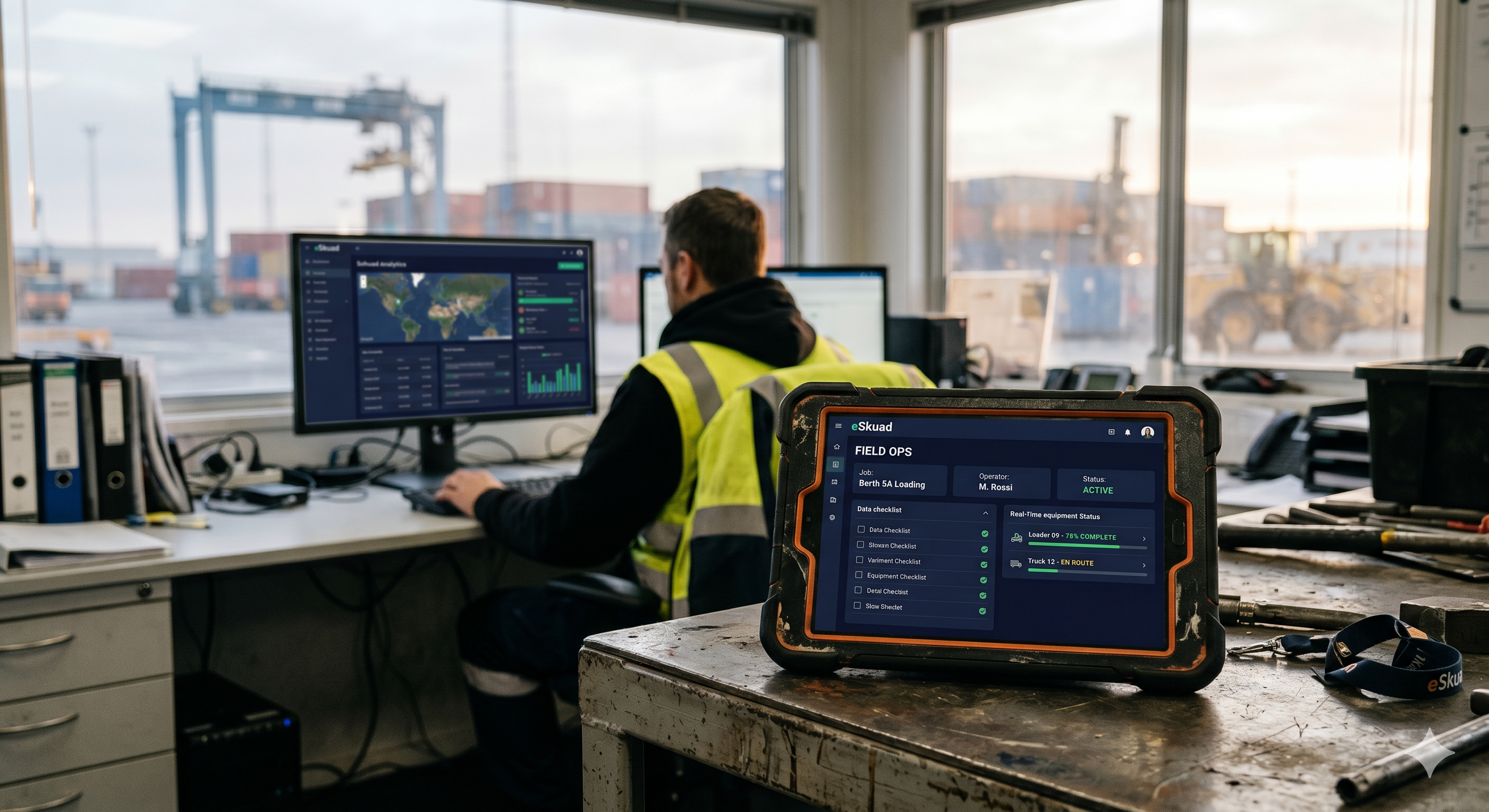
The structural solution is a single platform with purpose-built interfaces for both users: one for the field worker, one for the operations manager, sharing the same data layer with no translation required.
This is the architecture eSkuad was built around:
- The field interface is optimized for the conditions field workers actually face: offline-first data capture, fast form submission with no connectivity required, battery-smart MagikSync synchronization that sends data automatically the moment signal returns.
- The management interface is optimized for what operations managers need: real-time dashboards updated as field data syncs, compliance reports generated automatically from structured field records, exception alerts that surface problems without requiring a report request.
- The shared data layer means there is no translation. When a field worker submits an inspection record at pit level in an Atacama mine, the operations manager in the surface office sees it the moment the worker's device reconnects. Same data. No CSV. No analyst. No lag.
What the Transition Recovers
When industrial operations eliminate the Two-Product Problem, the translation layer cost disappears immediately:
- Badinotti Group eliminated 100% of their daily report transcription time — the entire analyst cost of moving data from field capture to client-ready reports.
- Ultraport recovered 60 hours per month by eliminating the shift paperwork translation process between field records and port management systems.
- Pandolfi Price achieved a 67% reduction in filing and report generation time — time that had been consumed by the translation layer between their field capture process and their reporting workflow.
These are not incremental improvements. They are the complete elimination of an architectural cost that had been hiding in plain sight.
Diagnosing Your Architecture
If any of the following describe your operation, you have a Two-Product Problem:
- Field data reaches the management dashboard through a manual export or copy-paste process
- There is a regular "data sync" meeting or task on the operations calendar
- The BI dashboard is updated daily or weekly, not in real time
- Analysts spend time cleaning or reconciling field data before it can be reported
- The "official" field record and the "management view" occasionally disagree
The cost of the Two-Product Problem is already on your P&L. It appears as analyst overtime, delayed decisions, compliance risk, and operations manager frustration. The question is whether you can see it clearly enough to fix it.
Get a Technical Diagnosis →
Frequently Asked Questions
What is the Two-Product Problem in field operations?
The Two-Product Problem is when industrial operations buy separate tools for field data capture and management visibility — tools that were never designed to work together. Between them sits a manual translation layer of CSV exports, copy-paste, and analyst reconciliation that costs 128+ hours per month and creates a 24–72 hour lag between field reality and the boardroom dashboard.
Why do industrial operations end up with two separate tools?
Because the procurement process optimizes for features in isolation. The field team buys the best offline-capable capture tool. The operations team buys the best BI platform. Both perform excellently for their users — but they were never designed to share a data layer. The failure only appears in production, when data needs to flow automatically between them and there is no path for it to do so.
What does the Two-Product Problem cost in practice?
It creates a translation layer that typically costs 128+ analyst hours per month in transcription and reconciliation, a 24–72 hour data lag, accumulating accuracy errors, and compliance exposure when field and management records diverge. Ultraport recovered 60 hours per month after eliminating this layer. Badinotti eliminated 100% of their daily report transcription cost.
How is eSkuad different from a two-product architecture?
eSkuad is a single platform with two purpose-built interfaces — the mobile app for field workers (offline-first, battery-optimized, simple under pressure) and the web platform for operations managers (real-time dashboards, compliance reports, exception alerts). Both share the same data layer. When a field worker submits a form, the operations manager sees it the moment connectivity returns. No export. No translation. No lag.
What is Dashboard Delusion and how does it relate to the Two-Product Problem?
Dashboard Delusion is the false sense of operational control executives experience when their management tools show green metrics while field data is still in transit through the translation layer. The Two-Product Problem is the structural cause — when field and management tools don't share a data layer, the dashboard is always a historical document, not a live picture. Eliminating the Two-Product Problem eliminates Dashboard Delusion.