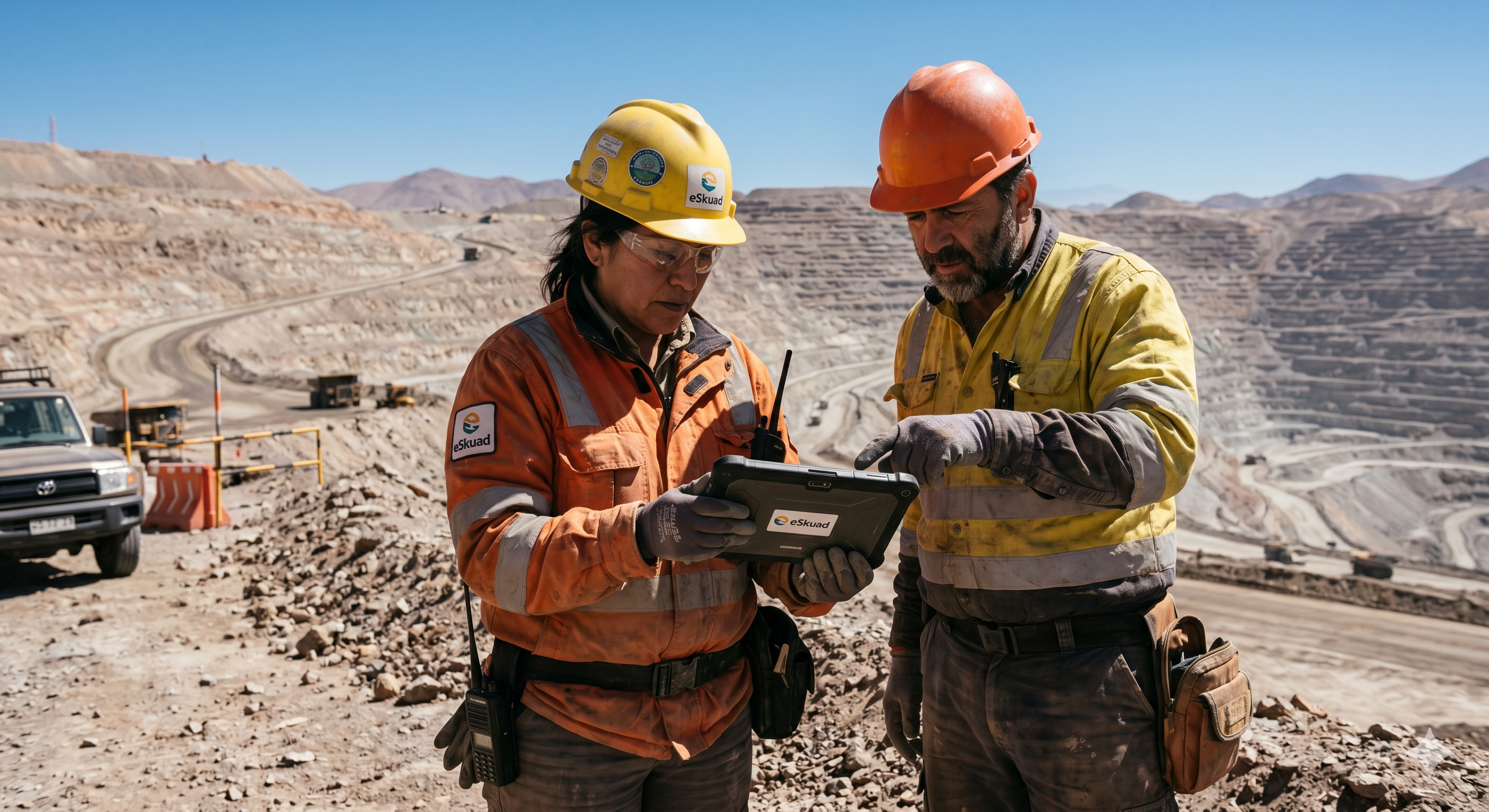
A mining inspector in the Atacama walks three kilometers to reach the haul truck maintenance zone. She has no signal — the site is 4,200 meters above sea level and the nearest repeater is two ridges away. She fills out the inspection form on paper, noting three hydraulic faults on the primary loader. At end of shift, the paper form travels back to the operations hut, waits for the analyst to transcribe it, and appears in the operations dashboard 38 hours later — labeled "current."
The hydraulic fault that could have been addressed that afternoon is now a repair that took the loader offline for four days.
This is the First Mile problem in mining — and it costs extraction operations across the Americas thousands of dollars monthly in deferred maintenance, compliance risk, and decisions made on data that no longer reflects reality.
Why Mining Field Operations Are Different
Mining sites impose conditions that expose the assumptions built into most field software:
- Zero connectivity at extraction zones. Open-pit mines, underground operations, and remote processing facilities frequently operate with no cellular signal and no Wi-Fi. Software that assumes connectivity fails at the exact location where most field data is generated.
- Extreme physical conditions. Dust, heat, altitude, vibration, and wet conditions in the Atacama, Andes, and US western mining regions mean devices get dirty, workers wear gloves, and data entry windows are measured in seconds — not minutes.
- High compliance stakes. Mining operations are subject to safety authority inspections, environmental regulations, and equipment certification requirements that mandate accurate, timestamped records. A paper form with a missing signature is a compliance exposure. A lost form is a liability.
- Shift handoff criticality. In continuous extraction operations, the outgoing shift's field data is the incoming shift's operating context. A 38-hour data lag doesn't just slow reporting — it means the incoming shift supervisor starts their rotation blind.
What the Data Gap Costs Mining Operations
Based on eSkuad's analysis of mining and extraction operations across South America and the US, the systematic delay between field events and digital records generates a predictable set of downstream costs — what we call the Shadow Tax:
- Deferred maintenance compounding into equipment failure. When hydraulic faults, conveyor wear indicators, and equipment anomalies are recorded on paper and transcribed 24–48 hours later, the maintenance window closes before the work order is created. Minor faults become emergency repairs. Emergency repairs shut down production.
- Safety incidents that escalate before response. A near-miss event captured on paper at shift end doesn't trigger a response protocol until the next morning at earliest. The conditions that caused the near-miss remain in place through the intervening shift.
- Compliance gaps that surface at audit time. Paper-based inspection records are incomplete, unsigned, or illegible. When a safety authority requests 90 days of inspection records, the documentation doesn't hold up. Fines and corrective action plans are the result.
- Analyst hours consumed by transcription. Skilled data analysts in mining operations often spend the majority of their time moving data from paper to system. This is the Shadow Tax made visible: highly paid talent doing work that should be eliminated entirely.
Pandolfi Price, a winery and agricultural operation with mining-adjacent field conditions, deployed eSkuad across their field operations and recorded a 22% drop in maintenance costs, a 73% decline in machinery failure detention time, and a 67% reduction in filing and reporting time — driven by closing the same data gap that mining operations face.
What Offline-First Field Operations Software Delivers in Mining
The requirements for field operations software that actually works in mining are specific:
Local-first data capture. The software must store form data on the device at the moment of capture — not "save when connected." When an inspector submits a hydraulic fault report 4,200 meters above sea level with no signal, that data must be guaranteed to exist on the device and sync automatically when signal appears. eSkuad's MagikSync engine does this by design — data lives on the device first, the cloud second.
Battery optimization for full-shift operation. Mining shifts run 10–12 hours. A mobile application that drains battery in four hours is not a field tool — it's a liability. Battery-aware architecture is a requirement, not a feature.
Glove-compatible UX. Large tap targets, minimal typing, photo capture with single-tap, and GPS auto-population at form submission. An inspector in PPE gear submitting a form in 30 seconds is the design target — not a desktop form resized for mobile.
GPS coordinates and photo evidence. Mining compliance records require location data and photographic evidence. An app that captures only text is not a compliance tool. Native GPS stamping and photo attachment at the field level — captured offline, synced with the record — meet the evidentiary standard.
Real-time visibility for shift supervisors and operations managers. When data syncs from the field, the operations manager sees it immediately on a live dashboard. Shift handoffs become informed transitions instead of guesses. Maintenance teams receive automatic work order triggers from field findings. The 38-hour lag becomes a minutes-lag.
How Mining Operations Use eSkuad
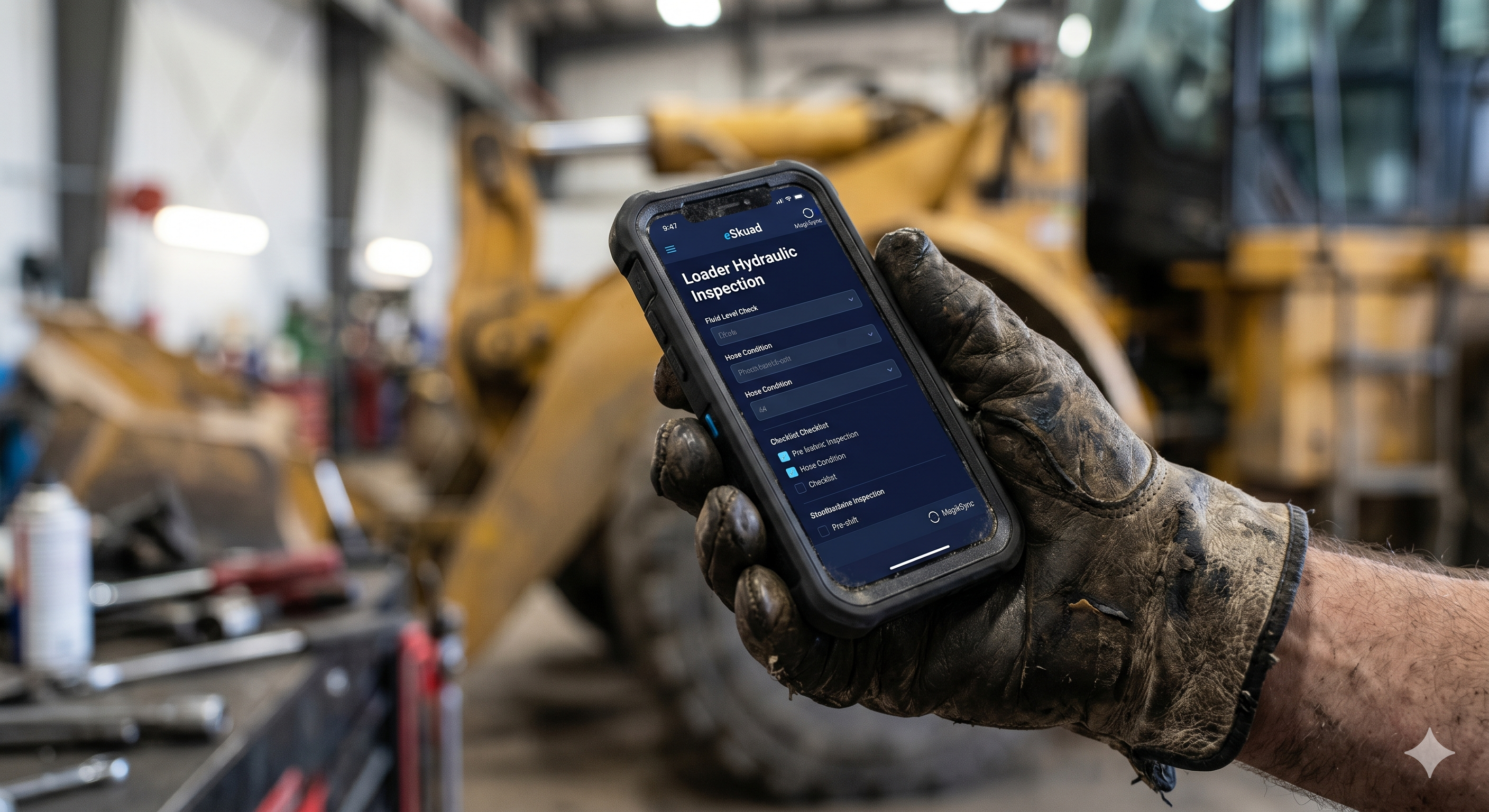
Mining and extraction teams deploy eSkuad across three primary workflows:
Equipment inspections and maintenance records. Inspectors capture fault reports, fluid levels, tire conditions, and safety checks offline. Reports sync automatically. Findings trigger maintenance work orders without manual intervention. Equipment history is searchable, timestamped, and audit-ready.
Safety audits and incident reporting. Near-miss events, PPE compliance checks, and safety observations are captured with GPS, photo, and digital signature at the moment they occur. Supervisor notifications fire automatically. Compliance records are immutable and exportable on demand.
Shift reports and production tracking. Shift supervisors submit end-of-shift production data, workforce counts, and operational notes before leaving the site. The incoming shift has full context. The operations manager has the day's picture before the morning review meeting starts.
Getting Started
eSkuad's free tier supports up to 5 users with no time limit and no credit card. The standard deployment approach for mining operations: run one workflow — an equipment inspection, a shift report, or a safety audit — on one team at one site. Measure the difference in data lag, compliance coverage, and analyst time before and after. The ROI calculation is usually immediate.
For enterprise-scale deployments with SOC 2 Type 2 compliance requirements, dedicated support, and ERP integration, the Enterprise tier delivers without the multi-month implementation timeline of legacy industrial software.
Frequently Asked Questions
Does field operations software work in mines with no cell service?
Most field software fails without connectivity — it stores data locally as a fallback but doesn't guarantee sync or data integrity when offline for extended periods. eSkuad is built local-first: data lives on the device by default and syncs automatically when signal appears, with no manual intervention required. In mining operations with multi-day connectivity gaps, this architecture difference is the difference between a working system and a system that works sometimes.
What compliance records does mining field software need to capture?
Mining compliance requirements vary by jurisdiction but typically include: equipment inspection records with timestamped findings, safety near-miss and incident reports with GPS location, PPE compliance audits, environmental monitoring records, and shift handoff documentation. eSkuad captures all of these with digital signatures, GPS coordinates, and photo evidence — generating audit-ready records that meet safety authority requirements without paper transcription.
How does field operations software integrate with mining ERP systems?
eSkuad's Enterprise tier provides an unlimited API for integration with ERP and BI tools. Field data captured by inspectors and shift supervisors flows automatically into downstream systems — maintenance management, compliance reporting, production dashboards — without the manual export and upload steps that create data lag in paper-based operations.
What is the First Mile problem in mining operations?
The First Mile problem is the systematic gap between where mining value is created — the haul road, the extraction face, the maintenance bay — and the digital systems that are supposed to manage it. In remote sites with no connectivity, field data captured on paper reaches the dashboard 24–72 hours late, if at all. The First Mile gap is the root cause of deferred maintenance, compliance failures, and operational decisions made on stale data.
How is eSkuad different from general inspection apps for mining?
General inspection apps are generic mobile forms with offline capability added as a secondary feature. eSkuad was built specifically for industrial field operations — including mining — with local-first architecture, battery optimization for extended shifts, compliance-grade audit trails, and operational visibility dashboards that surface field data to managers in real time. The difference is most visible in zero-connectivity environments: generic apps treat offline as an edge case; eSkuad treats it as the default state.